
What Is OCPP? A Plain-English Guide for EV Charging Infrastructure

If you are managing a new commercial or industrial infrastructure project, you have likely encountered the acronym OCPP. This standard is a fundamental requirement for reliable, scalable charging networks. Understanding how it functions is essential for ensuring your equipment remains manageable and eligible for funding.
What OCPP Does
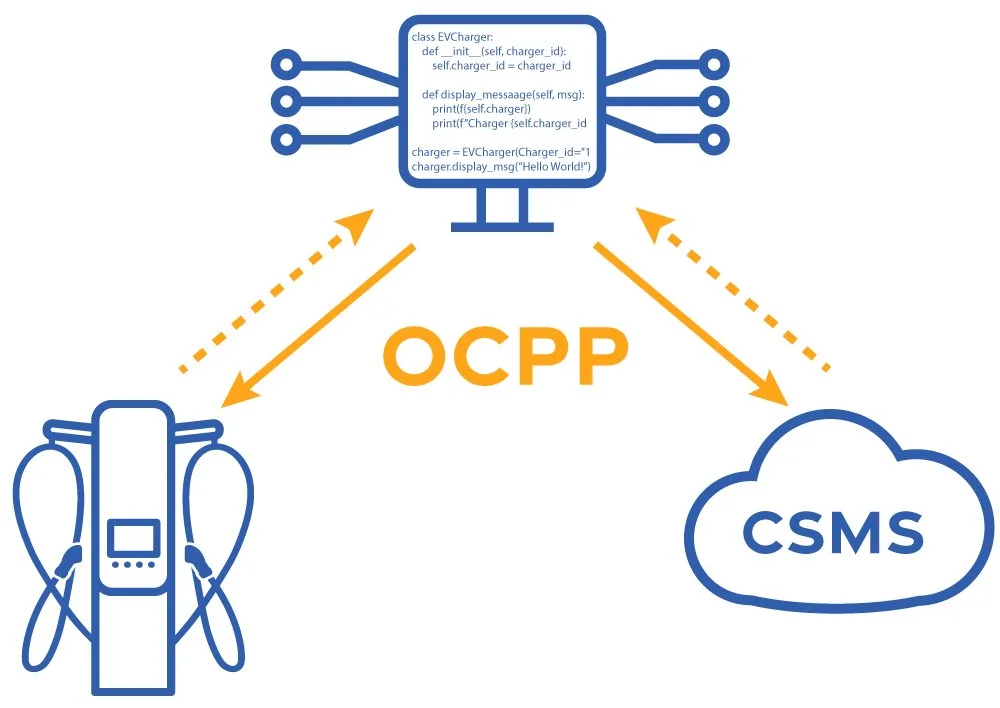
Every commercial EV charger requires a software system to manage operations. This software is known as a Charging Station Management System (CSMS). The CSMS allow s operators to remotely monitor stations, initiate sessions, track energy consumption, and process billing without requiring on-site personnel.
OCPP, or Open Charge Point Protocol, is the standardized language that allows the charger hardware and the CSMS software to communicate.
Before this protocol was established, many manufacturers used proprietary systems. This created "vendor lock-in," where buying a specific brand of charger forced you to use that same brand’s software. Standardizing this communication allows for a more flexible and competitive marketplace.
Why It Matters to Your Project
For property owners, fleet managers, and municipalities, confirming OCPP compliance is a critical step in the procurement process.
Eliminating Vendor Lock-in: With an OCPP-compliant system, you retain the freedom to switch hardware vendors or management software without replacing your entire infrastructure.
Operational Reliability: Standardized protocols support advanced features like intelligent load management and proactive 24/7 monitoring, which are core to the EV Range Platform.
Funding Eligibility: Federal and state programs often mandate OCPP compliance. For example, the NEVI (National Electric Vehicle Infrastructure) Formula Program requires specific versions of OCPP to qualify for a portion of its $5 billion in available funding.
Understanding the Versions: OCPP 1.6 vs. 2.0.1
You will primarily encounter two versions of the protocol in the current market:
OCPP 1.6: This has been the industry workhorse since 2015. It reliably handles core functions such as session management and basic load balancing.
OCPP 2.0.1: Released in 2020 by the Open Charge Alliance, this is the current recommended standard. It offers enhanced security, improved energy management, and native support for "Plug and Charge".
As of 2026, NEVI-funded sites are required to utilize OCPP 2.0.1. Even for private commercial or industrial sites, specifying 2.0.1 compatibility is a recommended strategy to future-proof your investment.
Verifying Compliance
Compliance is verified through formal certification programs managed by the Open Charge Alliance.
OCPP 1.6 Certification has been available since 2019.
OCPP 2.0.1 Certification launched in 2023.
When evaluating partners, always request certification documentation. This ensures that the hardware and software have undergone independent interoperability testing, rather than relying solely on a vendor's claims.
The Bottom Line
OCPP is the communication bridge that ensures your EV charging hardware and management software work together seamlessly. It prevents lock-in, enables remote operational support, and is a prerequisite for most public funding.
At EV Range, our platform is built on these open standards to provide high-uptime, specialized solutions for high-demand markets.


EV Range is currently offering a limited portfolio of shovel-ready, 30C-eligible sites available for immediate deployment. For investors and commercial operators, the primary barrier to maximizing infrastructure ROI is the time required to identify, license, and engineer compliant locations before federal deadlines. We have removed that barrier.